
Industrial Solar
Why load pattern comes first
Industrial solar projects fail more often from wrong assumptions about load than from any hardware fault. A plant that runs three shifts, has heavy motor starting currents, or draws power overnight needs a very different design from a single-shift unit. We begin with a detailed study of your load curve, contract demand and tariff slabs, then size and configure the system around how you actually consume power. This is the difference between a system that looks good on paper and one that delivers the projected savings.
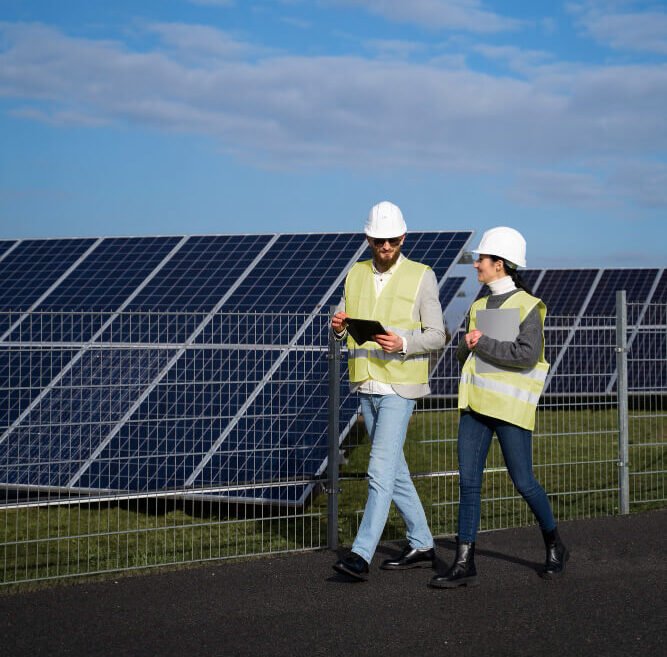
Rooftop and ground-mounted options
- Rooftop systems on factory sheds and warehouses: use existing roof area to offset daytime load.
- Ground-mounted systems on spare land: scale beyond roof limits for larger generation.
- Hybrid layouts: combine rooftop and ground arrays where the site allows.
Built for industrial reliability
Our modules carry a robust mechanical load rating, PID-resistant materials and 100 percent EL and flash testing, so they hold up in dusty, hot and demanding industrial environments. We design the balance of system, structures and cabling to the same standard, with safety run to ISO 45001 practices.
Captive and open-access ready
Whether you want a captive plant for self-consumption or are exploring open-access procurement, we structure the project to fit your regulatory and commercial position, with complete documentation for approvals and audits.
FAQs
We model your actual load curve, contract demand and tariff structure, then size the system to maximise self-consumption and savings rather than simply filling the roof.
Solar primarily reduces energy charges by offsetting units consumed during the day. Combined with the right design, it can also help manage peak draw. We quantify both in the feasibility study.
Yes. Where roof area is limited, we design ground-mounted or hybrid systems on available land to reach the required capacity.